
Online service
Service hours: Monday to Saturday 9:00-18:00
Please choose online customer service:
Please choose online customer service:
0755-83483730 / 23823366
Title: Industrial Automation and Control Products: Revolutionizing Practical Applications
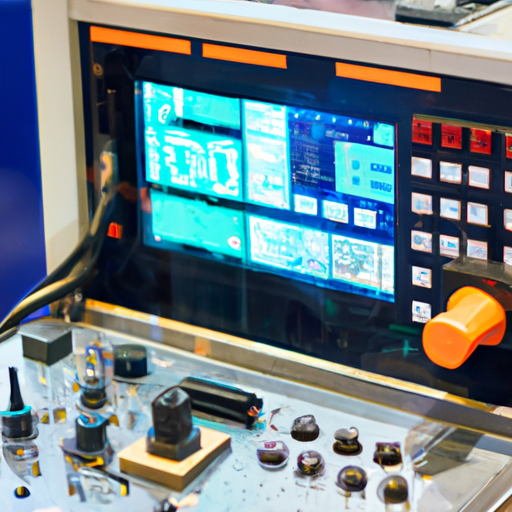
1. Enhancing Efficiency and Productivity (300 words) Industrial automation and control products play a crucial role in streamlining processes and optimizing productivity. By automating repetitive and mundane tasks, these products enable businesses to allocate their human resources to more complex and value-added activities. PLCs, for instance, are programmable devices that control and monitor machinery, ensuring precise and consistent operations. This automation reduces human error, increases production speed, and minimizes downtime, resulting in enhanced efficiency and productivity.
2. Improving Safety and Risk Management (300 words) Industrial automation and control products also contribute significantly to improving workplace safety and risk management. By replacing manual labor with automated systems, these products reduce the exposure of workers to hazardous environments and potentially dangerous tasks. Sensors and monitoring devices can detect anomalies, such as temperature variations or gas leaks, triggering immediate alerts and preventing accidents. Additionally, robotics and automated machinery can handle heavy loads or perform intricate tasks that may pose risks to human workers.
3. Enabling Real-time Monitoring and Data Analysis (300 words) One of the key advantages of industrial automation and control products is their ability to provide real-time monitoring and data analysis. HMIs allow operators to visualize and control processes, providing a comprehensive overview of the production line. This real-time monitoring enables quick identification of bottlenecks, faults, or deviations from desired parameters, allowing for prompt corrective actions. Moreover, the data collected by these products can be analyzed to identify patterns, optimize processes, and make informed decisions, leading to continuous improvement and cost savings.
4. Facilitating Flexibility and Adaptability (300 words) In today's dynamic business environment, flexibility and adaptability are crucial for success. Industrial automation and control products enable businesses to respond quickly to changing market demands and customize their production processes. PLCs, for example, can be easily reprogrammed to accommodate different product specifications or production volumes. This flexibility allows businesses to reduce time-to-market, increase product variety, and adapt to customer preferences, ultimately gaining a competitive edge.
5. Challenges and Future Prospects (250 words) While industrial automation and control products offer numerous benefits, their implementation also presents challenges. The initial investment cost can be significant, especially for small and medium-sized enterprises. Additionally, integrating these products into existing systems may require specialized expertise and training for employees. Cybersecurity is another concern, as interconnected systems are vulnerable to cyber threats. However, advancements in technology and increased awareness are addressing these challenges.
The future prospects for industrial automation and control products are promising. The advent of the Internet of Things (IoT) and artificial intelligence (AI) is revolutionizing the industry. IoT enables seamless connectivity between devices, allowing for enhanced data exchange and remote monitoring. AI algorithms can analyze vast amounts of data, enabling predictive maintenance and optimizing production processes. Furthermore, collaborative robots, or cobots, are becoming more prevalent, working alongside human operators to improve efficiency and safety.
Conclusion (100 words) Industrial automation and control products have transformed practical applications across various industries, enhancing efficiency, safety, and adaptability. These products enable businesses to streamline processes, monitor operations in real-time, and make data-driven decisions. While challenges exist, advancements in technology and increased awareness are addressing these concerns. The future prospects for industrial automation and control products are promising, with IoT, AI, and cobots set to revolutionize the industry further. Embracing these technologies will undoubtedly lead to increased competitiveness, improved productivity, and safer work environments.